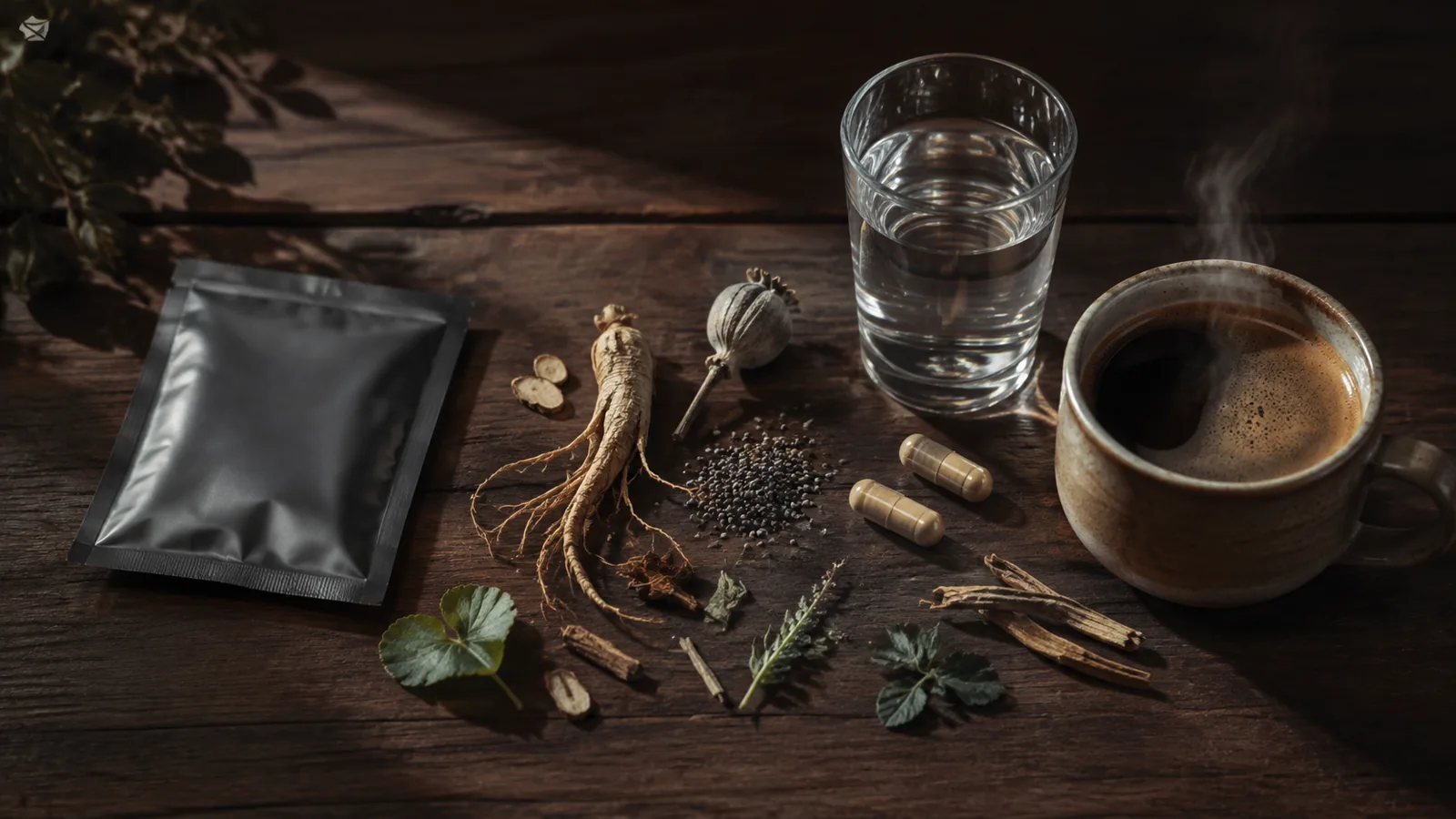



AliPrime contains LJBoost™ Tongkat Ali, a standardised extract. This is not the same as simply ground root. Powder and extract differ in how they are made, the concentration of particular compounds and how closely they can be matched to a studied ingredient.
What Is Root Powder?
Root powder is produced mechanically: the Eurycoma longifolia root is dried and ground. It retains a broad range of plant material, including fibre and compounds that do not readily pass into water or alcohol.
The composition of the powder depends on the plant’s variety and age, growing location, harvest time, part of the root, drying and storage. The same weight of powder from two batches does not necessarily contain the same amount of marker compounds.
How an Extract Is Made
During extraction, the plant material is brought into contact with a solvent, such as water or a water-alcohol mixture. Some plant compounds move into the liquid, which can then be removed to produce a dry extract for capsules.
The solvent and process determine which compounds are extracted more effectively. Water and alcohol extracts from the same root may have different chemical profiles. “Extract” describes a process, but it does not make all extracts interchangeable.
What the Drug-to-Extract Ratio Means
A botanical ingredient may be labelled with a ratio such as 10:1. This usually indicates how much dry starting material was used to produce one part of the extract. It does not mean that one capsule is strictly equivalent in effect to a specific amount of root.
The process is selective: some compounds are extracted, others remain in the plant material, and the composition may then be adjusted. Without information on the solvent, extraction yield and marker compounds, a ratio such as 10:1 or 100:1 does not identify the “strongest” product.
What Standardisation Means
Standardisation helps make extract batches more consistent. One or more chemical markers are selected, measured and maintained within a target range. A marker is useful for quality control, but it is not always the compound responsible for a plant’s proposed effect.
The NIH Office of Dietary Supplements explains that the active components of many botanicals are not fully known, and the word “standardised” alone does not guarantee quality, safety or effectiveness. It matters which marker was measured, by what method and whether it applies to the extract studied in people.
Comparing Two Forms of Tongkat Ali
| Question | Root powder | Standardised extract |
|---|---|---|
| How it is made | Dried and ground | Some compounds are extracted with a solvent and concentrated |
| What it contains | Broad composition of the original plant material | Profile depends on extraction technology |
| Batch consistency | May vary considerably | Controlled using selected markers |
| What the weight means | Milligrams describe the mass of powder | Milligrams describe extract mass, not starting root |
| Relation to a study | Evidence needs to use the same form | Evidence needs the same or a comparable characterised extract |
For a practical comparison, check the Latin plant name, plant part, preparation type, extraction solvent, drug-to-extract ratio, marker compounds, serving size and ingredient manufacturer. One large number cannot replace this information.
What a Study of a Different Extract Found
In a 2013 study, 64 people with moderate stress were randomly assigned to a standardised water extract called Physta™ or placebo for four weeks. Some mood scales and salivary cortisol and testosterone measures changed.
The study is a useful example of precise ingredient identification: it tested a particular proprietary water extract, serving and group of participants. Its results cannot be applied to root powder, an alcohol extract or another branded ingredient simply because all are called tongkat ali.
How LJBoost™ Fits into AliPrime
AliPrime contains LJBoost™ Tongkat Ali together with tribulus terrestris, maca root and ginseng. One capsule contains 500 mg of the entire blend; the pack contains 60 capsules. Capsule weight is not the weight of Tongkat Ali and does not show the amount of marker compounds.
LJBoost™ is an extract, not simple root powder. It is also not identical to Physta™, the ingredient used in the 2013 study. A batch specification and marker testing support consistency; the clinical effect of finished AliPrime would need to be assessed separately from studies of one ingredient.
Take two AliPrime capsules daily after food with water. The recommended period is at least four weeks. Do not exceed the daily serving. If you have cardiovascular disease or take medicines, consult a healthcare professional. The product is not a medicine.
Powder and extract cannot be compared by milligrams alone. For Tongkat Ali, the extraction method, markers and match to the studied preparation matter. Standardisation supports consistency; it does not turn every extract into a proven treatment or make different branded ingredients equivalent.