


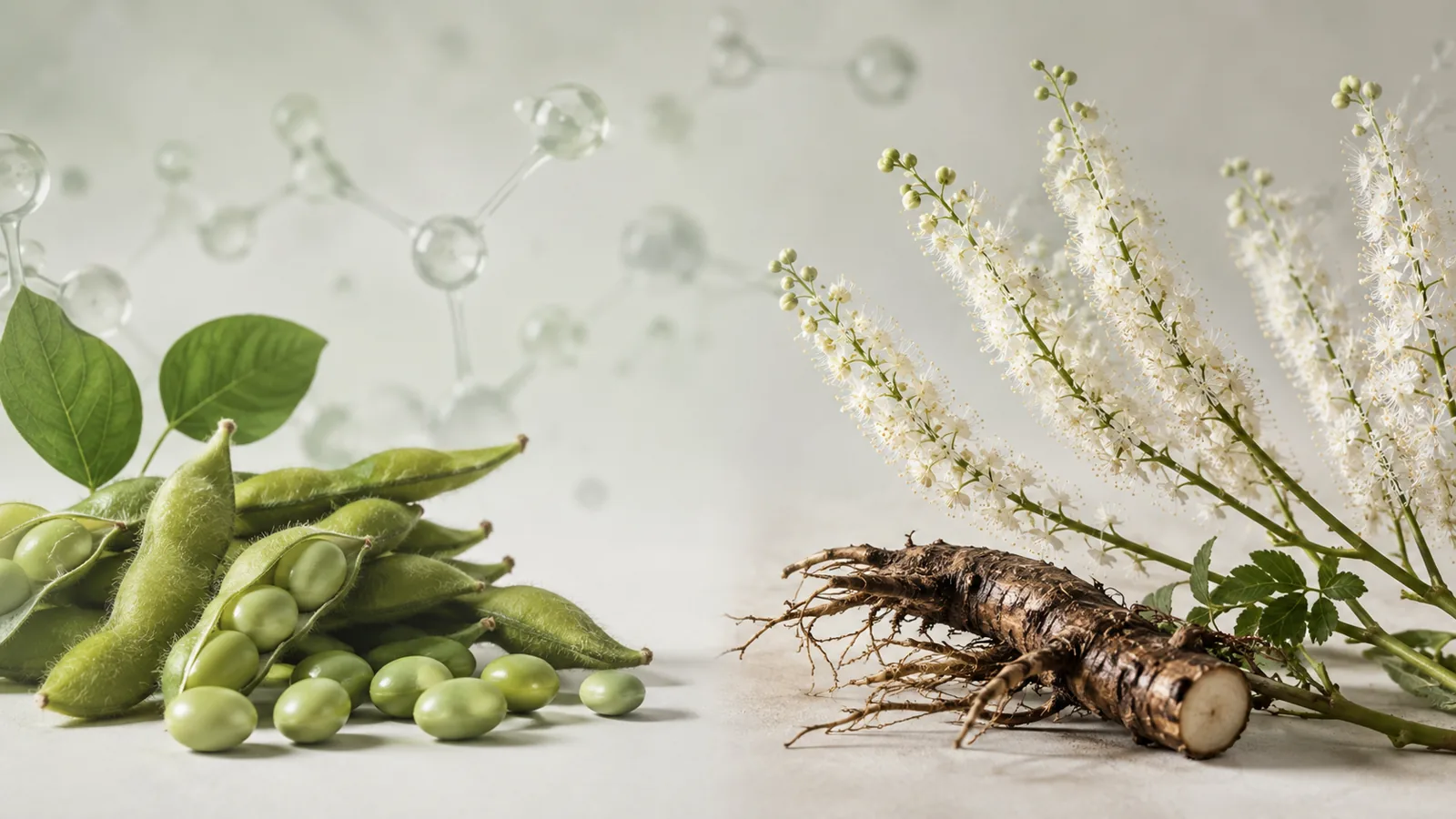
AlphaMax V+ contains both soy isoflavones and black cohosh. These ingredients are often discussed in the context of menopause, but they represent two different botanical approaches. They should not be grouped under the label “natural hormones” or treated as interchangeable.
What are soy isoflavones?
Isoflavones are naturally occurring compounds in soy with a structure that is partly similar to estrogen. For this reason, they are classified as phytoestrogens. Structural similarity does not make them human hormones: their activity, interaction with receptors, and effects are different.
Isoflavones occur in soy foods and are also available in concentrated supplements. These forms should not automatically be treated as equivalent: a serving of food contains protein and other nutrients, while an extract has a different composition and concentration.
How black cohosh differs
Black cohosh is a North American plant. Supplements use its root or rhizome. It has been studied for menopausal symptoms, but it is not classified as a source of soy isoflavones. It is a distinct botanical ingredient with a different chemical composition.
Having both ingredients in one formula does not mean they double the same mechanism. It is more accurate to view them as two different parts of a multi-ingredient blend and not infer that the formula works from the familiarity of individual ingredient names.
What soy research shows
According to the NCCIH overview of soy, supplements containing isoflavones or soy protein may slightly reduce the frequency and severity of hot flashes, although research findings are not fully consistent. This is a measured conclusion: a possible average effect does not guarantee the same response for every woman.
Results depend on the product studied, dose, duration, starting symptoms, and participant characteristics. Findings for a particular extract cannot be applied without verification to any formula that lists soy among many ingredients.
What is known about black cohosh?
The NCCIH overview of black cohosh notes that many products have been evaluated in studies and that a 2023 review found potential benefits for overall menopausal symptoms and hot flashes. Reliable evidence is lacking for several other uses.
Safety also matters: rare cases of liver injury have been reported in people taking products labeled as black cohosh, although the causal relationship remains unclear. If you notice dark urine, unusual fatigue, or yellowing of the skin, stop taking the product and seek medical care.
How the two approaches appear in AlphaMax V+
| Ingredient | Type | How to understand its role |
|---|---|---|
| Soy isoflavones | Phytoestrogenic compounds | Do not call them hormones; account for mixed research findings |
| Black cohosh | Root or rhizome extract | Consider it separately from soy and account for safety limitations |
| The rest of the formula | Botanical extracts and nutrients | Do not combine evidence for separate ingredients into a promise about the blend |
AlphaMax V+ also contains cranberry, ginkgo, turmeric, dong quai, chaste tree, damiana, flax, coenzyme Q10, NMN, SynForU-HerCare, and Pycnogenol. This combination makes the product a complex formula, but it cannot predict an individual response based on one ingredient alone.
When to consult a healthcare professional
Before using AlphaMax V+, consult a healthcare professional if you are pregnant or breastfeeding, have a hormone-sensitive condition or liver disease, or take medication regularly. Plant-derived ingredients can still have interactions and contraindications.
Consider menopause medicines, anticoagulants, and other supplements together. It may help to show your clinician the full list rather than just the product that seems most important. Take one sachet of AlphaMax V+ daily; do not increase the serving on your own.
How to track changes without unrealistic expectations
Before starting, write down what you want to track: hot flash frequency, nighttime waking, mood, or overall comfort. Change one part of your routine at a time and assess it under similar conditions. A diary does not prove an ingredient’s effect, but it can help you describe your experience during a consultation.
Severe or unusual symptoms, bleeding after menopause, chest pain, shortness of breath, or a sudden decline in well-being require medical assessment. A botanical formula may be part of a considered routine, but it does not replace diagnosis or prescribed treatment.


