


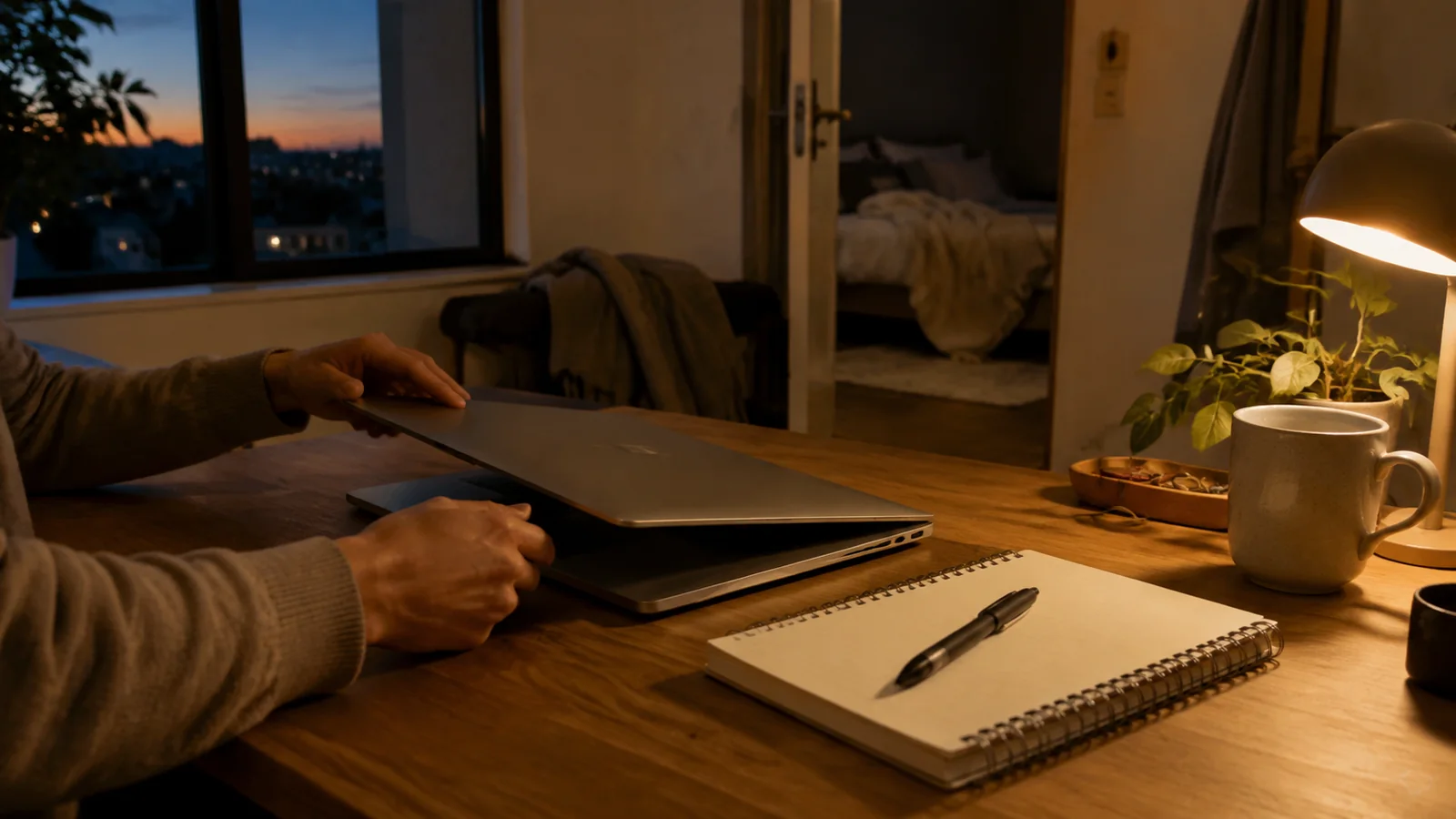
Sometimes your body is asking for rest while your mind keeps replaying a work meeting. Emails, an unfinished task, or a conversation you wish you could redo come back to mind. On evenings like this, it can help to give the workday a clear endpoint and make the last hour calmer, instead of trying to “force yourself to sleep.”
Why feeling tired does not always mean you are ready to sleep
Fatigue reflects the effort you have spent during the day, but falling asleep is also affected by nervous system arousal, lighting, your usual schedule, and what you do before bed. You can feel physically tired while still thinking through a task, checking messages, or sitting under bright lights.
The US National Heart, Lung, and Blood Institute (NHLBI) recommends using the final hour before bed for quiet activities, avoiding bright artificial light, and keeping regular bedtimes and wake times when possible. This does not promise that you will fall asleep within a certain number of minutes; it is a way to remove some signals that promote alertness. NHLBI healthy sleep habits.
What keeps the workday open
It is usually not just one screen. Several things can keep you in work mode:
- Notifications leave room for a new task at any moment.
- Unwritten tasks have to be held in your memory.
- Bright overhead lighting and stimulating content do not signal a shift to nighttime.
- Trying to “quickly finish one more thing” pushes rest later.
- Checking the clock can turn falling asleep into a deadline-driven task.
A systematic review of 159 studies on psychological detachment from work found that boundaries between work and personal time, workload, and communication technologies are linked with the ability to mentally switch off from work. The review does not prove that turning off one notification will solve a sleep problem, but it supports a practical idea: the workday needs a visible boundary. A systematic review of 159 studies.
Ten minutes to close the day
It is easier to finish work with a short routine you can repeat at the office or at home.
- Write down unfinished tasks. A task name and next action are enough: “send the design—check the mobile version.”
- Choose the first step for tomorrow. You do not need a perfect plan for the whole week; decide where you will start.
- Close work tabs and apps. If you need to remain available for an urgent issue, keep one agreed channel rather than all notifications.
- Move work items out of sight. Close the laptop and move it away from the dining table; put papers in one folder.
- Say that the day is over. A simple phrase such as “I’ll continue tomorrow from this point” can help you avoid treating every new thought as a command to return to work immediately.
A small laboratory study offers an interesting example of writing tasks down. Before one night in a lab, 57 healthy participants aged 18–30 spent five minutes writing either a list of future tasks or a list of tasks they had already completed. The group that wrote future tasks fell asleep faster. The sample was small, the participants’ age range was limited, and the observation lasted one night, so the result does not make a list a universal remedy. But writing down open tasks is a simple way to see whether it becomes easier to stop carrying them in your head.
An example of the last hour before bed
Times here are counted back from your usual bedtime. If you go to bed at 11:30 p.m., the example starts at 10:30 p.m.
| Time before bed | What to do | Why |
|---|---|---|
| 60–45 minutes | Close work channels, write down tomorrow’s tasks, dim overhead lights | Mark the end of work and reduce new stimulation |
| 45–25 minutes | Wash up or take a warm shower, prepare clothes and items for the morning | Shift to familiar actions that require few decisions |
| 25–10 minutes | Read a paper book, listen to calm audio, or do gentle stretching | Give your attention a predictable, quiet activity |
| Last 10 minutes | Air the bedroom, move your phone away from the bed, turn off bright lights | Make the room dark, quiet, and cool |
You do not have to do every item. Start with two actions you can realistically repeat, such as closing the work chat and dimming the lights at the same time each night. The routine should reduce the number of decisions, not become another evening project.
Light and screens: brightness and content both matter
A screen before bed is more than a source of light. Messaging, news, short videos, and work engage your attention in different ways. That is why a display’s night mode does not make every kind of content neutral.
In a crossover study published in 2026, 24 adults with sleep complaints spent eight laboratory nights under different lighting and device-use conditions. When electronic devices were prohibited for two hours before bed, participants felt sleepier and, on average, fell asleep faster according to polysomnography. One cool LED-lighting condition also increased sleep-onset time compared with fluorescent light at the same color temperature. This was a small study with a specific protocol; it does not establish one brightness level or a mandatory two-hour ban for everyone. A modest practical takeaway is to reduce light levels in the evening and separate the bed from work-related or emotionally stimulating screen activities. The 2026 crossover study.
If your thoughts return after you go to bed
Do not argue with every thought or try to solve the whole task in your head. Keep paper nearby: briefly write down what you remembered, then return to a quiet activity. “Check the figures in the report—open the spreadsheet and verify May” is more useful than the vague note “don’t forget the report.”
If you are lying in bed and becoming increasingly frustrated about not sleeping, you can move to another place for a while, keep the light dim, and do something quiet. Return to bed when you feel sleepy. Do not start working or turn on bright lights; the aim is to reduce the tension around trying to fall asleep.
How to include SunSet in an evening routine
SunSet by YES Global contains Affron® saffron extract, lavender, valerian, chamomile, passionflower, magnesium, L-theanine, and other plant-based ingredients. Each serving comes as a premeasured tablet, so it can be associated with a regular evening routine—for example, when work notifications are off and the room lights are dimmed.
According to the directions, take one SunSet tablet every evening before bed; one pack contains 15 tablets. Do not increase the amount to try to fall asleep faster. After taking it, do not drive if you feel sleepy, and do not combine it with sedative medicines or alcohol without consulting a professional. SunSet is not a medicine and does not replace assessment of persistent sleep problems. View SunSet ingredients and directions.
When an evening routine is not enough
Discuss sleep with a healthcare professional if difficulty falling asleep or waking during the night keeps recurring and interferes with work, study, driving, or everyday activities. It may help to keep a diary for one or two weeks beforehand, noting bedtimes and wake times, nighttime waking, naps, caffeine, alcohol, physical activity, and how you feel in the morning. NHLBI recommends this diary when preparing to discuss sleep problems. NHLBI guidance on diagnosing insomnia.
Regular loud snoring, pauses in breathing, gasping or sudden breaths during sleep, and pronounced daytime sleepiness deserve separate attention. These signs may be related to sleep apnea rather than evening habits and need assessment. NHLBI information on sleep apnea symptoms.
For tonight, one clear step is enough: write down unfinished tasks, close the work channel, and choose a quiet activity for the rest of the evening. A repeatable boundary between work and rest is more useful than a complicated routine you manage only once.